


| Just stand there and talk! | |
| Thursday, October 30, 2025 | |
When you are six, learning to whistle is a big deal. When you are six, learning to snap your fingers is also a big deal. And may I remind you that when you are six, losing your first tooth is definitely a big deal? So it was that we received spirited updates on all these major life events from Emma, who is indeed six years old. As we listened in person or on FaceTime, we heard her snaps grow louder and her whistle less airy. We watched as her tooth grew wigglier and wigglier. But on FaceTime—or any time—nothing was wigglier than Emma herself. She bopped, blinked, and bounced in a blur. Keeping her inside the phone's camera frame was not possible. "Now you see her, now you don't" comes to mind. Emma's eight-year-old sister, Ava, observed all of these shenanigans. Being much more of a cut-to-the-chase kid, her capacity for these antics had maxed out. One famous FaceTime conversation found Emma in the middle of her ants-in-the-pants performance when Ava blurted, "Will ya just stand there and talk?!" We shared a good laugh, and while Emma did not settle down, a question settled on me: Does God ever feel that way about us? Does He ever watch us crushing our jobs, rushing our lives, and want to say, "Hey, you! Will ya just stand there and talk?!" But we're "busy," you see. Busy about too many things that won't matter six weeks from now, let alone six months or six years. And these things that don't ultimately matter keep us from the only things that do. Like prayer. The King of kings and Lord of lords desires an audience with you. Every. Single. Day. With check-ins throughout the day! Hey, you! Will ya just stand there (or kneel there) and talk?!
Photo by Karoline Lewis on Unsplash |
|
| Invisible and Undesirable | |
| Thursday, October 23, 2025 | |
We waited at the counter—but nobody seemed to notice. At a certain fast food Mexican chain (no names here, but their logo might feature a purple bell), we attempted to pay for our lunch. Mind you, we’d already placed our order at the kiosk, so as not to “trouble” any of the workers with—well, customers. We might still be there waiting were it not for a crew member who stepped out of the restroom and saw us stranded at the counter. She took pity on us, then took cash from us. We’ve had the same “you-folks-at-the-counter-don’t-exist” experience at a certain golden arched place and other “quick serve” restaurants. Maybe you have, too. It doesn’t seem to matter whether you’ve committed the unpardonable sin of failing to order at the kiosk. The simple fact that you’re standing at the counter makes you invisible and—dare I add, undesirable—to the average “server.” I understand the need to prioritize drive-through customers. But this campaign of coldness toward folks that stop in rather drive through is just odd. These restaurants pretend to welcome customers but prefer just to sell food—quite apart from any interaction with any customer. Ever. Question: Is that how we treat guests at church? “Absolutely not!” you say. “We’ve got a welcoming team in the parking lot, a welcoming team at the doors and….” I hear you. But I’m asking YOU about YOUR attitude. Are our churches just selling spiritual food, or are we—every one of us—interacting with every guest we see? Are we cocooned with comfortable friends—or are we actively seeking to engage a stranger? I admit to struggling here. Sometimes, I’m friendly and outgoing. Other times, I ignore newer folks like they’re standing at the counter at a fast-food place. But… You’re a server. I’m a server. Let’s be very careful that we don’t treat guests as if they’re invisible or undesirable.
|
|
| To Hate Evil | |
| Thursday, October 16, 2025 | |
Got clobbered by a Scripture verse this week. Proverbs 8:13 proclaims, “To fear the Lord is to hate evil.” I’m guessing your reaction is like mine was—initially. With a dismissive yawn, you’re saying, “No problem there. I definitely hate evil.” Not so fast. What about the evil of profanity in the TV programs we stream? What about the evil of sensuality in the movies we pay good money to see? What about the evil in the books we read? And what about the blogs and social media voices we champion whose words spew a literary napalm over our political foes? What about the evil (it can only be called that) which hardens our hearts to the plight of the poor, the disenfranchised, the folks who don’t vote like we do. Do we hate that evil? Isn't it true we tolerate—and often celebrate—the voices of snarky politicians who think like we think? Yet harsh words are never holy words. Could you honestly say you’re never greedy? Isn’t it true that we are often consumed with wanting just a little more money, just a little more recognition, just a little more sex? A bigger house. A bigger diamond. A bigger SUV. The Bible calls this preoccupation of ours idolatry (Colossians 3:5). And God hates the evil of idolatry. The hard truth is, if we don’t truly hate evil, we merely dislike it. And there’s a vast gulf between the two. I could go on, but you get the idea. Besides, the inventory of my own evil demands a humility best expressed in silent confession.
|
|
| Umpires of Peace | |
| Thursday, October 09, 2025 | |
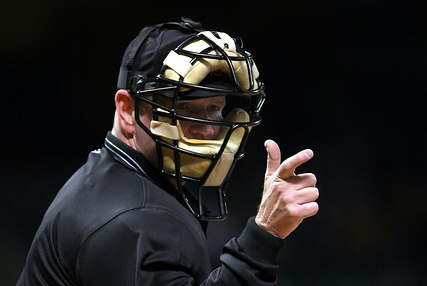
They're the most colorful part of any baseball game as they howl, "Strike!" Or "Safe!" I'm talking about umpires, of course. And if you've ever watched a game, you've heard the bark of their bluster over the roar of the crowd: “You’re out!” Umpires understand their call must be clear and confident. Now, you might not be much of a baseball fan. It could be the slow pace. Or the spitting. Or…(I’ll leave it at that). But the fact remains, Scripture calls you to be an umpire, of sorts. Colossians 3:15 urges us,
That word, rule, is better translated as "umpire." In Paul’s day, the culture was full of sports events. Just like today, those games required umpires. No video replay back then. No automated ball-strike challenge system. So, they had umpires to preside over their games:
It turns out that the Greek word for our word, "rule," means to act as an umpire, making the call in a conflict between contending forces. To umpire means to direct, control, rule, arbitrate, govern, prevail." But the arena here is not a stadium. It’s our hearts. Because that’s where the real wars are fought, right? We often act as if we're powerless over our feelings and emotions. We're not! When it comes to having—or not having—the peace of Christ, YOU are the umpire! Consider—the essential job of an umpire is to declare:
That's precisely what we're supposed to do with every thought that enters our mind, "taking captive every thought," as Paul put it. We can’t control our circumstances, but we must control our thoughts. Because if peace does not rule our hearts, then doubt, fear, and anxiety will. Our thoughts must be stopped, frisked, X-rayed, judged—and when necessary—thrown out. Because if we do not say no to sinful thoughts—“You’re out!”—we are really saying, “You’re safe. You’re okay.” And peace is gone. Maintaining peace is an all-day, every-day pursuit. And it starts when we step up to umpire our thoughts.
|
|
| The Stuff of Murder | |
| Thursday, October 02, 2025 | |
Ever thought about how many people are killed by animals every day? Steve Jenkins collects these kinds of statistics. Following is a list of the top nine animal killers on the planet—and how many they kill in an average day:
Were you surprised by that list? I sure was. After all, who's afraid of a teeny snail? Probably not you. But in a given day, they kill as many people as snakes do! Ironically, the prize for the deadliest goes to the smallest: the mosquito, of which there are an estimated 110 trillion buzzing around the planet. And every last one of them is a potential carrier of that lethally infectious disease, malaria. Biblically speaking, the same idea applies to people like you and me. Though our fists might prove deadly in a fight, we kill far more with something much smaller—our tongue. We’ve all heard that the tongue has the potential for great destruction. But that’s way too kind an assessment. The tongue—my tongue—is a killer. It’s a weapon for murder! Yours, too.
This is exponentially more serious than “mere” offense! This is the stuff of murder! So, if our tongues are so deadly, what's the answer? In Psalms 141:3, David prayed, "Set a guard, LORD, over my mouth. Keep watch over the door of my lips." Isn't that precisely what we need—a guard over our mouths and a sentry securing the "door of our lips"?
*Source: Steve Jenkins, One Day By the Numbers, Clarion Books, an imprint of HarperCollins Publishers. Copyright © 2022 Image by Franco Patrizia from Pixabay
|
|
| Records per page First Prev 1 2 3 4 5 6 7 8 9 10 of 143 Next Last | |



 Jon Gauger Jon Gauger |
|||||||||||||||
| Thursday Thought | |||||||||||||||
Recent Posts
|